Warning: file_get_contents(/home/www/settings/mirror_forum_db_enable_sql): failed to open stream: No such file or directory in /var/www/html/content/Forum/functions.php on line 8
EU has the world's best censorship teams, to be enhanced by artificial intelligence soon!
Without any local assets, not even the slightest computer science know-how!
We offer our own heads, and those of our neighbors and partners for earning the loyalty prize.
What good does it do?
AFD now around 30% of voters nationwide in Germany.
The rest of Europe is the same. Juust like 100 years ago.
I said it before and was ridiculed for it, here.
Fuck you! Don't you know that we are the good and the best there ever were?!
The EU is holding up the flame against the unpredictable Donald, even!
Guys, lets keep learning from Iran and other shithole countries...
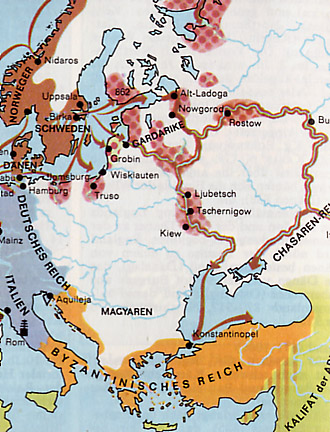
"Bolli brought with him a great deal of money and many treasures that the great lord had given him. Upon his return home, his clothes were so lavish that he wore only garments of purple and velvet, and all his weapons were inlaid with gold. He was called Bolli the Magnificent. Bolli rode from his ship with eleven companions, all of whom wore the finest clothes and sat on gilded saddles. All were handsome men, but Bolli was by far the most handsome. He wore velvet garments given to him by the emperor and over them a cloak of fine red cloth. At his side he carried his sword, Footbiter, whose hilt was inlaid with gold, as was the blade. He wore a golden helmet and carried a red shield at his side, on which a knight was painted in gold. <â¦> And wherever they spent the night, the women could do nothing but stare at the magnificent finery of Bolli and his companions."
Some historical context for how we got here from Anne Applebaum (this is just the opening of her talk.. you can read the whole thing here).
...Why are you here? Why did you take time out on a Wednesday night to come here, to the Judenplatz, to hear a »Speech for Europe«? Why did you want to join this annual tradition?
Let me take a guess at two of your motives. First, many of you are here because you remember the catastrophe that engulfed this city, this country, and this continent during the Second World War, more than 80 years ago. You knew that this lecture, in this place, would recall that historyâof the war, of the Holocaust, of the hatred and the hungerâand that it would honor the memory of the victims.
Secondly, I am guessing that many of you fear that some version of that catastrophe might return. If that is the case, then you are in good company, and indeed you are part of a very long tradition. Since 1945, several generations of Europeans have been working very hard to prevent another disaster like the Second World War. They wrote history books and put up monuments. They organized events like this one. As you can see, they still do.
They also reorganized their societies. As Austrians were reconstructing Vienna, as other Europeans were rebuilding Paris and Berlin, they were not just putting things back to the way they were before. Surrounded by rubble, they decided to build something brand-new: a set of institutions designed to promote liberal democracy, the rule of law, cooperation between states, economic integration and, eventually, a single market for trade.
These institutions were intended both to promote prosperity and to prevent the return of the imperial and genocidal ambitions that had done such damage to this city, and to so many other cities. Instead of returning to the old system of rivalries, protectionism, and warring armies, Europeans created the European Union and a host of other organizations that connected them to one another and to the world through ties of commerce, trade, travel, and diplomacy.
The Europe that emerged from this process represents an enormous achievementâan unprecedented achievement, in fact; one with no real parallel anywhere else in the world. Thanks to the efforts of that postwar generation, Europe is safer, richer, and more peaceful than ever before in its history. European countries are also more sovereign. Thanks to eight decades of collective deterrence, Europeans have been able to develop their own national cultures within a framework of peace, instead of perpetual war. Thanks to the European Union, Europeans can preserve their art, literature, and architecture, including the buildings that surround us here. Thanks to a network of treaties and agreements, Europeans have also built democracies that protect individual freedom and citizensâ rights.
This success does have a downside. Because these institutions worked so well, people began to imagine that they were not the result of hard work and difficult compromises but rather something natural, just some »bureaucracies« that emerged by themselves. Because we had those 80 years of peace, people started taking the laws and norms that ensure peace for granted.
If you came tonight because you fear that these institutions are now in danger, you are correct. For right now, at this moment, they are indeed under attack. The challenge comes, first and foremost, from within our own societies. All across Europe and North America, discarded texts, forgotten concepts, and dimly remembered theories are being revived by people who donât remember why they were discredited three generations ago.
Many have, for example, adopted old attitudes to parliamentary democracy, and are now channeling the same scorn for elections that the autocrats of the 20th century once expressed. Lenin dismissed parliaments as nothing more than »bourgeois democracy.« Hitler called parliamentary democracy »one of the gravest symptoms of human decline.« When you hear European politicians talking about the »degeneracy« of democracy, or the »weakness« of liberalism, remember that these same words were also used in the 1930s, by groups describing themselves as both Left and Right.
Some are also rediscovering old political tactics, for example the idea that politics should focus not on creating consensus but on building an existential, potentially violent distinction between »friends« and »enemies.« They may not even know that this idea comes from the German philosopher Carl Schmitt, popular in the Third Reich, who dismissed liberal politics as a sham.
Nor are these the only ideas that have returned. Ethnic nationalism, for example, the belief that nations are better if they are somehow purer, however purity is defined, is also back. So is theocracy, or dominionism. This is the belief that the only good societies are those run by the church. So is an older idea of sovereignty, a vision of the state that gives all power to a ruler or ruling party that is, by definition, immune from criticism, even when they violate the rights of their subjects.
Indeed, the downgrading of human rights as something sentimental and weak is a very old idea. The replacement of news-gathering and fact-checking with propagandaâwe have lived through that before too, along with attempts to control and manipulate access to information. Similarly, we donât have to look far back in history to discover that the creation of scapegoats, minority groups whose presence can be blamed for economic losses or social distress, is a political tactic that has been tried before.
These are European ideas, and they come from European history. But they are also being reinforced from outside of Europe. We hear them, for example, from the Russians, in the propaganda that they use to justify a whole range of military, cyber, and hybrid attacks on Europe. Russiaâs war on Ukraine is sometimes described, including recently by the American vice president, as if it were nothing more than a territorial dispute, a scuffle over lines on a map. But when Russia denies that Ukraine is a real nation; when Russia builds concentration camps on occupied Ukrainian territory; when Russia bans the Ukrainian language and systematically arrests mayors, teachers, journalists, and priests, then Russia is also attacking the Europe that was built after 1945, the Europe whose borders are not supposed to be changed by force. Russia invaded Ukraine not only to destroy Ukraine, but also to prove that treaties are meaningless, alliances are weak, and that brute force still decides the fate of nations. By waging an imperialist war of conquest, Russia seeks to undermine Europeâs post-imperial order.
In this sense, the Russian attack on Ukraine is also an attack on the European Union. Europeans may imagine that the EU is a mere bureaucratic inconvenience. But the Russians have never believed that. On the contrary, the Russian president has long understood that when unified, Europe can resist Russian influence and Russian corruption. When divided, Europeans find it far more difficult to turn down Russian offers of special treatment, or lucrative secret deals.
That is why, for two decades now, Russian propagandists have belittled the Union, mocked its institutions and, echoing some Europeans, portrayed it as decadent, divided, overregulated, or doomed. Nor is their policy limited simply to words or memes. They also seek actively to create chaos and division. A few months ago, agents paid by Russia placed explosives on a Polish railway line, in an attempt to create mass casualties. Russian drones have been used to hamper traffic at airports all over Europe. Russian assassins have killed people in Britain, Germany, and Spain.
Russian money backs European political parties and leaders whose victories would limit Europeâs ability to defend European territory. That is why the Russians fund or amplify anti-European political parties as well as separatist movements. Russia wants to replace the Europe of law with a Europe tolerant of kleptocracy: a Europe in which every country can be separately pressured, separately threatened, separately bought.
Do you know what is really funny about all you nostalgic one-party-state / monarchist types is?
The enormous effort such states put into propaganda.
Why do this when the one party / state / leader / monarch / führer is the sole arbiter of all things political?
Could it be that even these systems know they ultimately also rely on the will of the people? And if you screw it up, you're out.
Looks like you are left with democracy one way or another, just at different degrees of efficiency, coercion and/or corruption.
Putin is about to be the next one to learn this the hard way.
From Google AI:
Viktor Orbán's government has been widely characterized by systemic, high-level corruption and the dismantling of democratic checks, described by experts as a "clientelist" system where public funds and EU resources are steered toward a close circle of wealthy allies. His administration has been ranked as the most corrupt in the European Union
From Wikipedia: Corruption in Hungary remains a significant problem as the country has posted declining performance in international assessments. In 2023, the country was identified as the worst-performing European Union country in Transparency International's Corruption Perception Index. This decline in Hungary's position in the index covers most of the past decade, highlighting a troubling trend.<1>
See the ongoing UAE-backed RSF massacres in Sudan...
... or the previously US/Europe-supported UAE/Saudi war on Yemen that killed more than 400K people.